Founding Partners Program 2026

Apply

Predictive Aviation Intelligence

A second mind in the cockpit.

We are building aviation's predictive intelligence layer. It analyzes weather, fuel, route, terrain and nearby airports, simulates what could happen next and shows the crew their best options in seconds. The final decision always belongs to the pilot.

Prototype in developmentPartner program open

Aviantis Console
Conceptual visualization
Risks before takeoffConceptual visualization
  1. > analyze route origin → destination
  2. metar dest wind 290/18G26
  3. notam runway 22 closed 19–23Z
  4. fuel reserve is tight
  5. > 3 conditions to review
What is happening?
Strong crosswind at destination and a runway closure right in your arrival window.
What could happen next?
If the wind holds, the available runway is at its limit and your alternate changes the reserve you need.

Best options now

  1. 1Depart 25 min earlierArrive with the main runway openRecommended
  2. 2Alternate B with more fuel+18 min reserve · stable weatherAlternative
  3. 3Reschedule departureWind forecast to ease after 21ZAlternative

Conceptual visualization · illustrative scenario, not flight guidance

Designed around the data your operation already uses

  • METAR
  • TAF
  • NOTAM
  • POH/AFM performance
  • DEM terrain
  • Airports & runways
  • Fuel
  • Weight & balance
  • Winds aloft
  • Aircraft state

The problem

Too much information. Too little time.

When something goes wrong, the crew has to integrate weather, NOTAMs, performance, terrain and fuel while still flying the airplane. The data exists, but it is scattered, and the time to bring it together runs out.

Fragmentation

Weather, NOTAMs, performance, terrain and fuel live in different sources.

Limited time

An abnormal event shrinks the time available to integrate information and compare options.

Static procedures

Checklists and the QRH are essential, but they don't synthesize the geospatial context of the moment.

Nearest isn't always best

Wind, runway, terrain, obstacles and margin can change the right decision.

Cognitive overload

More data doesn't guarantee a better decision. Crews need less noise, not more screens.

The idea

  1. 01What is happening?
  2. 02What could happen next?
  3. 03What are my best options now?

Instead of twenty more data points, three answers.

Aviantis is designed to integrate the full context of the flight and reduce it to what matters right now.

How it works

From scattered data to an explainable decision.

Aviantis combines physics-based and geospatial models with AI to detect a relevant condition, simulate possible futures and rank the alternatives with their reasons.

Planned sources

Conceptual visualization
  • Weather
  • NOTAM
  • Fuel
  • Route
  • Terrain
  • Airports & runways
  • Performance
  • Aircraft state
Decision Engine
Live simulation
  1. risk.detectedengine_power_loss
  2. envelope.computedwind 270/12
  3. candidates.found6
  4. candidates.rejected2 · terrain
  5. ranking.updatedB > C > A
  6. advice.readyB · margin +3 min
  1. 01

    Detect

    Identifies the condition that matters: a failure, low fuel, adverse weather or a restriction.

  2. 02

    Simulate

    Generates possible futures from the aircraft's actual state, not from a static plan.

  3. 03

    Analyze

    Compares trajectories, constraints, margins and uncertainty for every alternative.

  4. 04

    Recommend

    Ranks the options, explains why and shows what would change the recommendation.

Reproducible physics where safety demands it. AI where it adds verifiable value.

Before and during the flight

Before takeoff, it looks for risk. In the air, it thinks with you again.

A focused analysis of what's unusual before departure, and an adaptive analysis when something changes in flight.

Focused preflight

The unusual, before takeoff.

Low fuel, a reported failure, a restriction or adverse weather: it analyzes only what is relevant.

Fuel reserve below plan
NOTAM: runway closed in your arrival window
Forecast crosswind of 18 kt at destination

3 conditions to review

Adaptive in-flight analysis

When something changes, it simulates again.

When a new failure appears or the weather shifts, it recomputes from the current state and compares scenarios in seconds.

Modeled margin (min)AB
  • One recommendation, few alternatives

    Never an endless list.

  • Visible reasons

    Reach, margin, wind, runway, terrain and missing data.

  • Explicit uncertainty

    Separates verified, estimated and missing data.

  • Debrief and replay

    Compare decisions and learn from every scenario.

Illustrative scenario

Engine failure. Weather deteriorating. You need to land.

Normally the pilot reviews procedures, searches for airports, checks weather and computes distances while still flying. This is how that analysis could look with Aviantis, in seconds.

Illustrative scenarioConceptual visualization

Illustrative scenario and values based on a case study. Not flight guidance.

  1. T+00 s

    Detects the condition

    Total loss of power at 8,500 ft. Wind from 270° at 12 kt.

  2. T+02 s

    Simulates the real reach

    The glide envelope bends with the wind: the reach is not a circle.

  3. T+04 s

    Finds candidates

    Three airports and runways fall within theoretical reach.

  4. T+06 s

    Rules out the infeasible

    A, 18 NM away, crosses terrain the glide cannot clear with margin. C, 33 NM away, has uncertain weather.

  5. T+08 s

    Recommends and explains

    B, 26 NM away: suitable runway, lower terrain and an estimated margin of +3 min. If the wind veers, the ranking can change.

  6. Now

    The pilot decides

    The nearest wasn't the best. The final decision always belongs to the pilot.

Who it's for

For operations that can't leave a decision to chance.

We start in simulation and training, alongside operators who want to shape the product from day one.

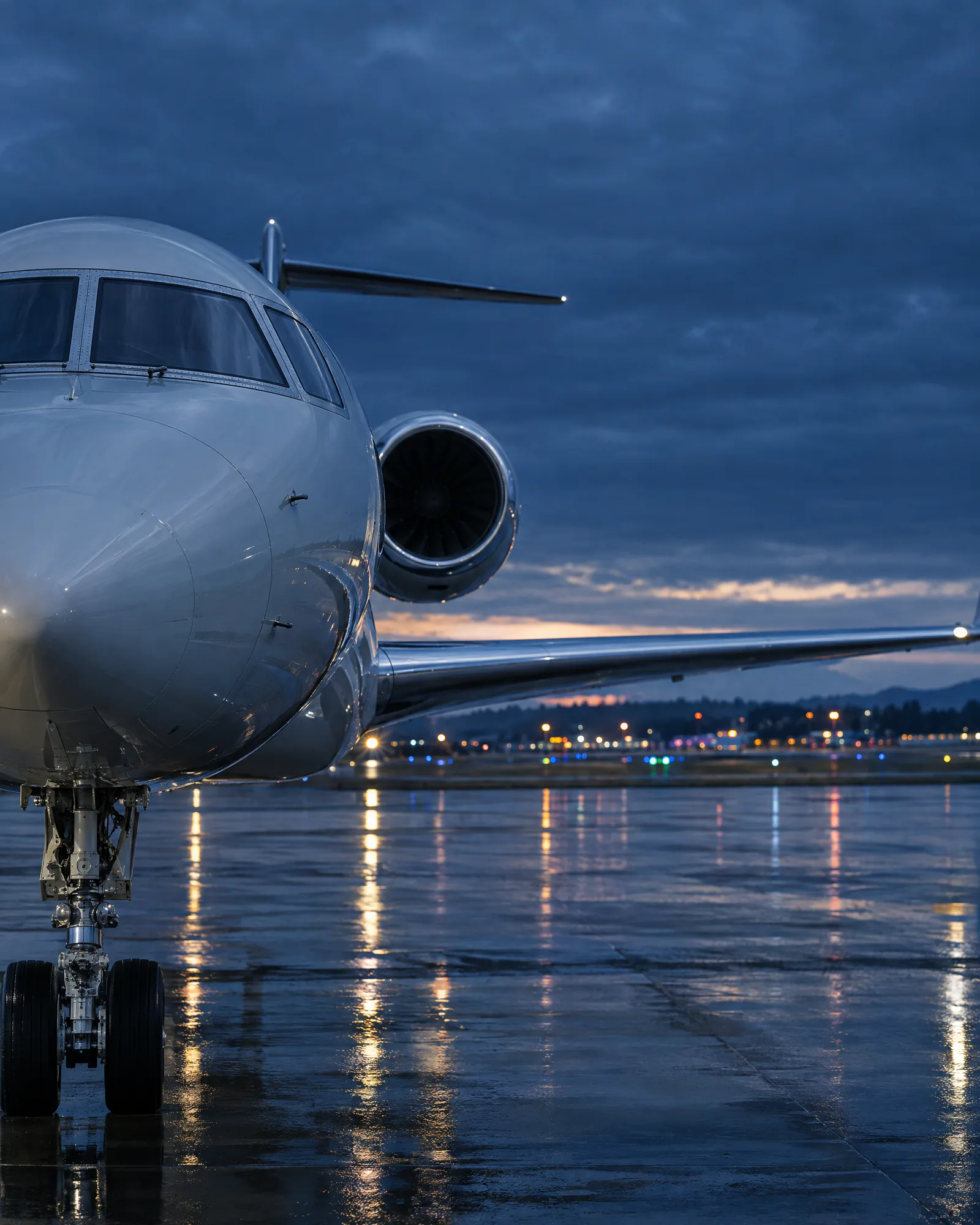
Business jet on the apron at blue hour

Small crews, variable routes and unfamiliar airports.

  • Preflight analysis focused on what's unusual about each mission.
  • Alternate comparison with wind, runway, terrain and margin.
  • A traceable record of every scenario for your safety management system (SMS).

How we start together

Scenarios from your most frequent routes, in the simulator first.

Request a demo

Safety by design

The pilot decides. Always.

In aviation, safety and evidence are part of the product from day one.

  • Pilot authority

    Decision support, never control of the aircraft.

  • Visible uncertainty

    Shows alternatives and margins, not false certainty.

  • Full traceability

    Every recommendation links back to its data, assumptions and model version.

  • Safe degradation

    When data is missing or confidence is low, it says so instead of improvising.

  • Physics first

    Deterministic models where safety demands reproducibility. Generative AI never replaces official procedures.

  • Validated in simulation

    We test first in simulators and controlled environments, with pilots and instructors.

Aviantis is not a certified system yet. Today its use is limited to simulation and training.

Founding Partners Program

Let's build Aviantis with your operation.

We are looking for a small group of operators, airlines and training centers to validate the product in simulation and define its path to operations together.

Apply to the program
  1. 01

    Conversation

    We learn about your fleet, your routes and the scenarios that worry you most.

  2. 02

    Tailored scenarios

    We design critical scenarios specific to your operation.

  3. 03

    Simulator pilot

    60 to 90 days with your pilots or instructors, measuring clarity, decision time and calibrated trust.

  4. 04

    Shared roadmap

    Together we prioritize integrations, aircraft and scenarios.

Evidence before breadth.

A sequence of dependencies, not a promised calendar.

TodayFuture vision
  1. Today
    1DemonstratorOne aircraft, one emergency, one decision engine.
  2. 2DeepeningData, uncertainty, validation and experience.
  3. 3CoverageMore critical scenarios on the same aircraft.
  4. 4Multi-aircraftNew aircraft and performance profiles.
  5. 5IntegrationsSimulators and real-time data sources.
  6. 6Certified operationHigher criticality, with safety and certification.
  7. 7Emergency assistanceAutomated assistance in defined scenarios.

What founding partners get

  • Early access to every version of the demonstrator.
  • Scenarios designed for your fleet and your routes.
  • Direct influence on the product roadmap.
  • Preferred launch terms.

Company

Why Aviantis exists

At 17, Alan crashed his first airplane. Luckily, it was in a simulator.

It took only a few seconds for one bad decision to lead to another. That's when he understood that when something goes wrong, the pilot has to decide with too much information and too little time.

So we asked ourselves: what if the pilot had a second mind helping them think?

A simulator has a reset button. A real flight doesn't.

That's why we're building Aviantis.

The team

Close to the aviation domain, with in-house software and AI capability and a quantitative background.

  • Guadalajara, Jalisco, Mexico
  • Selected for JEEI by REDi · 3rd edition
  • Alan Greco Hernández López

    CEO & Co-founder

    Aeronautical training at Aeria. Aviation, product, scenarios and partnerships.

  • Braulio Noé Hernández López

    Co-founder · AI & Software Systems

    AI, data, quantitative modeling and a financial perspective.

  • Jorge Lino Isaías Ponce Murguía

    Co-founder · AI & Software Development

    Software architecture, AI and product engineering.

FAQ

What operators ask us.

Is Aviantis an autopilot?

No. It is a decision-support system: it analyzes, simulates and explains alternatives. It does not control the aircraft.

Does it replace the pilot?

No. The final decision always belongs to the pilot. Aviantis gives them a second mind that analyzes while they focus on flying.

Is it certified?

Not yet. Today we work in simulation and training, which is where validation begins. Certification is part of the roadmap, with no promised dates.

What data does it use?

It is designed to combine aircraft state and performance, weather (METAR/TAF), NOTAMs, terrain, airports and runways, and fuel. Every data point is recorded with its source and age.

Which aircraft does it work with?

The first demonstrator focuses on a training aircraft and a total engine-loss scenario. Together with our founding partners we decide which aircraft and scenarios come next.

What does a pilot program look like?

A 60 to 90 day program in the simulator with your pilots or instructors, with tailored scenarios and metrics for clarity, decision time and trust.

What happens if data is missing?

It tells you. When data is missing or confidence is low, Aviantis states the limitation instead of improvising a recommendation.

How much does it cost?

We work on a B2B model: a pilot program and then a license sized to your operation. We quote each case.

Request a demo

Decide with more margin.

Tell us about your operation. We'll walk you through the conceptual demonstrator and what a pilot program with your team would look like.

  • Demo with the founding team
  • Scenarios relevant to your fleet
  • No commitment

Prefer email?contacto@navryx.co

Quick answers

Pre-written answers. Not a live AI assistant.

Is Aviantis an autopilot?

No. It is a decision-support system: it analyzes, simulates and explains alternatives. It does not control the aircraft.

Does it replace the pilot?

No. The final decision always belongs to the pilot. Aviantis gives them a second mind that analyzes while they focus on flying.

Is it certified?

Not yet. Today we work in simulation and training, which is where validation begins. Certification is part of the roadmap, with no promised dates.

How much does it cost?

We work on a B2B model: a pilot program and then a license sized to your operation. We quote each case.

Talk to the team